Final review
Ritual
Vocabulary
Jewish Lifecycle
Chayei Yehudi · The Jewish Lifecycle — womb to tomb
Birth, , naming, b'nai , marriage, divorce, illness, death and mourning.
Tip: hover (or tap) any underlined word for a quick definition.
Lesson video · Jewish Lifecycle, Part 1
Lesson video · Jewish Lifecycle, Part 2
Lesson video · Jewish Lifecycle, Part 3
1
The basics
Name, translation, date and length — the facts to have by heart.
Name and timing
- Hebrew name
- Chayei Yehudi
- English translation
- The Jewish Lifecycle — womb to tomb
- Date / timing
- From birth to death and mourning
- Length
- A lifetime
2
Meaning and story
Why this exists, what happened, and the values it carries.
What it means
- Jewish life is marked by rituals that sanctify each stage from birth to death.
- Each moment binds the individual to family, community and covenant.
Story and history
- Birth: P'ru U'rvu, be fruitful and multiply, frames the beginning of Jewish life.
- (bris): the covenant of circumcision, traditionally on the eighth day, performed by a , with a holding the baby; postponed when health requires. Describing the eighth day as 'human partnership with God' is one interpretation — the Torah's creation account itself describes six days of creation and rest on the seventh, not seven days of creation.
- Baby naming: Mi Sheberach, an aliyah l'Torah and Shehecheyanu.
- : redemption of a firstborn son, traditionally on the 31st day where applicable, involving Kohen, Levi and Yisrael.
- Traditional age is Bat at 12 for girls and Bar Mitzvah at 13 for boys, though many Conservative congregations celebrate girls' Bat Mitzvah at 13 as well: assuming religious responsibility — and Jewish education continues well beyond the ceremony.
- Marriage: , , , the bride circling the groom seven times (a widespread custom, not a universal requirement), , , the — seven blessings recited over the cup of wine — and the seudat , with and , and .
- Divorce: the (gett) is distinct from civil divorce; its timing is coordinated with the rabbi and Beth Din alongside the civil process rather than fixed as always following it.
- Illness: , Mi Sheberach, and — do not rely on miracles; passive and active euthanasia and suicide were curriculum discussion topics.
- Death and mourning: and by the , , burial as promptly as possible (subject to permitted delays and circumstances, rather than a fixed 48-hour rule) in the ground in a Jewish cemetery. begins after burial and lasts seven days (Shabbat and festivals affect its observance), followed by , , , , the grave marker and its , and El Malei , with belief in the World to Come and T'chiat HaMetim. Mourner's Kaddish itself sanctifies and praises God; its text does not describe death.
Major themes and values
- Covenant marked in the body and in time
- Community accompanies the individual at every stage
- Dignity of the body in life and in death
- Structured grief keeps mourners connected
3
Practice
Rituals, symbols, prayers and foods — and the reason behind each.
Rituals and observances
- when the baby is eight days old (postponed if not medically ready) with a and .
- Baby naming with Mi Sheberach, aliyah l'Torah and Shehecheyanu.
- on the 31st day where applicable.
- Traditionally Bat at 12, Bar Mitzvah at 13; many Conservative congregations mark Bat Mitzvah at 13.
- Wedding: , the bride circles the groom seven times, , , , the — seven blessings over the cup of wine — , , seudat .
- for divorce — distinct from and coordinated with, rather than always following, the civil divorce.
- and Mi Sheberach in illness.
- , , , prompt burial (as soon as possible, subject to permitted delays) in the ground in a Jewish cemetery, beginning after burial for seven days, , , , , grave marker and .
Why we do these rituals
- enacts covenant in the body; describing the eighth day as expressing partnership with God is a traditional interpretation (the Torah describes six days of creation and rest on the seventh).
- The symbolizes God's protection and the new Jewish home the couple is building.
- The sets out the marriage's obligations in writing.
- Seven blessings — the — are recited over the cup of wine, moving from the creation of the world to the joy of this couple: the wedding sits inside the whole story of creation.
- Where practiced, the bride circling the groom seven times is read as matching the seven days of creation — a custom, not a universal requirement, expressing a couple building a new world together.
- The breaking of the glass recalls the destruction of the Temple — brokenness remains present even at the height of joy.
- Prompt burial and honor the dignity of the body.
- , , , and the grave marker give grief a structure and keep mourners inside community.
Symbols and what they mean
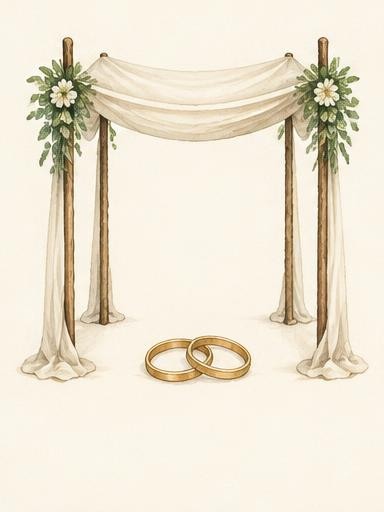
- Chuppah
- The new Jewish home the couple builds together.
- Breaking the glass
- Temple destruction; brokenness even in joy.
- Ketubah
- The marriage document and its obligations.
- Seven circles
- A widespread custom in which the bride circles the groom seven times, read as recalling the seven days of creation.
- Sheva Brachot
- Seven blessings over the cup of wine, from the creation of the world to the joy of this couple.
- Keriah
- The tear in the garment; grief made visible.
- Tachrichim
- Simple shrouds; equality in death.
Important prayers and readings
- Mi Sheberach
- Shehecheyanu
- El Malei
Foods
- Seudat — the celebratory meal after a wedding or lifecycle mitzvah
4
Words to know
The Hebrew vocabulary for this topic.
Vocabulary
- Brit Milah
- Covenant of circumcision, on the eighth day when medically safe.
- Mohel
- The one who performs the circumcision.
- Sandek
- The one who holds the baby at the brit.
- P'ru U'rvu
- Be fruitful and multiply.
- Pidyon HaBen
- Redemption of the firstborn son, traditionally on the 31st day.
- Aufruf
- Being called to the Torah before the wedding.
- Ketubah
- The Jewish marriage document.
- Bedeken
- The veiling of the bride.
- Chuppah
- The wedding canopy; the new Jewish home.
- Kiddushin
- The betrothal/sanctification portion of the wedding.
- Sheva Brachot
- The seven wedding blessings, recited over the cup of wine.
- Hakafot (seven circles)
- A bridal custom of circling the groom seven times, read as recalling the seven days of creation.
- Yichud
- The couple's private time after the ceremony.
- Chatan / Kallah
- Groom and bride.
- Mikveh
- Ritual bath.
- Get
- The Jewish divorce document.
- Bikkur Cholim
- Visiting the sick.
- Ayn Somchim al ha-Nes
- We do not rely on miracles.
- Taharah
- Ritual washing and purification of the body.
- Tachrichim
- Plain burial shrouds.
- Chevra Kadisha
- The burial society.
- Keriah
- The tearing of a garment by mourners.
- Shiva
- The first seven days of mourning.
- Sheloshim
- The first thirty days of mourning.
- Kaddish
- The mourner's prayer.
- Yahrzeit
- The annual anniversary of a death.
- Unveiling
- The dedication of the grave marker.
- T'chiat HaMetim
- Resurrection of the dead.
5
Beth Din prep
Answer these out loud before you sit down with the rabbis.
What I should be able to explain to the Beth Din
1Take me through the Jewish lifecycle from womb to tomb.
Answer:Birth: traditionally at 8 days for boys, baby naming for girls; for a firstborn son. Bar traditionally at 13, Bat Mitzvah traditionally at 12 (many Conservative congregations celebrate girls at 13 as well). Marriage under the with a ; a is a distinct Jewish divorce document, its timing coordinated with the rabbi and Beth Din alongside any civil divorce. when ill. At death: , prompt burial, , , , and the .2Explain : when, who, and what it means.
Answer:Traditionally on the 8th day after birth (even on Shabbat), performed by a ; it is postponed when the baby's health requires. It is the sign of the covenant between God and Abraham's descendants, and the baby receives his Hebrew name.3Explain the wedding step by step and what the and breaking glass mean.
Answer:Signing the (marriage contract), the (veiling), the ceremony under the , the ring, the Seven Blessings, then the groom breaks a glass. The chuppah is the new home, open on all sides for hospitality; the glass recalls the destroyed Temple — even in joy we remember.4How many blessings are said at a Jewish wedding, and why does the bride circle the groom seven times?
Answer:Seven blessings — the . By custom in many communities, the bride circles the groom seven times, often linked to the six days of creation and the seventh day of rest: together they are building a new world and home.5Explain the stages of mourning: , burial, , , , , .
Answer:: tearing a garment. Burial as promptly as possible, in a simple coffin, subject to permitted delays. : seven days of mourning at home, beginning after burial (Shabbat and festivals affect the observance). : the first 30 days. — which praises and sanctifies God rather than describing death — is said for 11 months for a parent. : the yearly anniversary. : dedicating the headstone, usually within the first year.6Explain and .
Answer: is the of visiting the sick. means "we do not rely on miracles" — we must also seek medical care and act, not only pray.
Key points to be ready to explain
The core ideas of this topic in brief — the things to be able to say in your own words.
- The bride's echo the seven circuits with the Torah on Simchat Torah; seven suggests a full week.