Shavuot
Shavuot · Weeks
The giving of the Torah and the festival of .
Tip: hover (or tap) any underlined word for a quick definition.
Lesson video · Shavuot
Beth Din priority
Lag B’Omer
- When
- 18 Iyar, usually May; the 33rd day of counting the between Passover and Shavuot; one day.
- Why
- A traditional explanation remembers the end of a plague among Rabbi Akiva’s students. The notes place this remembrance in the period of conflict with Rome; present the plague account as tradition, not as a precisely dated historical event.
- How and what it means
- Picnics and outdoor celebration mark this joyful day during the count. It belongs between Yom HaAtzmaut and Shavuot in this review sequence.
Beth Din priority
Shavuot
- When
- May–June; seven weeks after Passover; 6–7 , two days in traditional observance, and 6 Sivan, one day, in Israel.
- Why
- The Feast of Weeks celebrates receiving the Torah and the at Mount Sinai, and the and harvest of the season. Passover takes us out of Egypt; Shavuot brings us to Sinai.
- How and what it means
- Read the and the Book of Ruth. Ruth freely joins the Jewish people and their God; her story is a model for conversion: “Your people shall be my people, and your God my God.”
- Study Torah, traditionally through the night, and eat . These observances connect learning and celebration to receiving the Torah.
The basics
Name, translation, date and length — the facts to have by heart.
Name and timing
- Hebrew name
- Shavuot
- English translation
- Weeks
- Time of year
- Late spring (May or June), seven weeks after Passover
- Date / timing
- 6 Sivan, at the end of the Counting of the Omer; one day in Israel, two days in traditional diaspora observance
- Length
- 1 day in Israel; 2 days in the traditional diaspora
- Historical reason
- The giving of the Torah at Sinai.
- Agricultural reason
- — the early summer harvest offering.
Meaning and story
Why this exists, what happened, and the values it carries.
The story, told as a story
Read this first — it connects the symbols, rituals and words below.
Seven weeks after Passover, the freed Israelites arrive at Mount Sinai. Shavuot celebrates what happened there: the giving of the Torah and the . The people who left Egypt in the story of Pesach now receive the Torah. It also falls at the time of the , the early summer harvest offering.
On Shavuot we read the Book of Ruth. Ruth is the first convert in history recorded as a convert: she accepted the Torah voluntarily, just as the Jewish people did at Sinai. Her words — "Your people shall be my people, and your God my God" — are the heart of the story, and a woman is the hero, just as on Purim. For anyone choosing Judaism, Ruth is the model: Sinai was a choice, and so was hers.
What it means
- Shavuot celebrates the gift of the Torah.
- It also has an agricultural dimension as the festival of .
Story and history: key points
- Revelation at Sinai and the giving of the .
Major themes and values
- Revelation
- The structure of the Bible /
- The ongoing interpretation of Torah after Sinai
Practice
Rituals, symbols, prayers and foods — and the reason behind each.
Rituals and observances
- Counting of the from Pesach to Shavuot, with Lag B'Omer along the way.
- — study through the night.
- Reading the and the Book of Ruth.
- Eating .
Why we do these rituals
- Counting the links liberation at Pesach to revelation at Shavuot: freedom leads to Torah.
- Studying all night expresses eagerness to receive Torah.
- Ruth is read as the story of one who joins the Jewish people and accepts Torah.
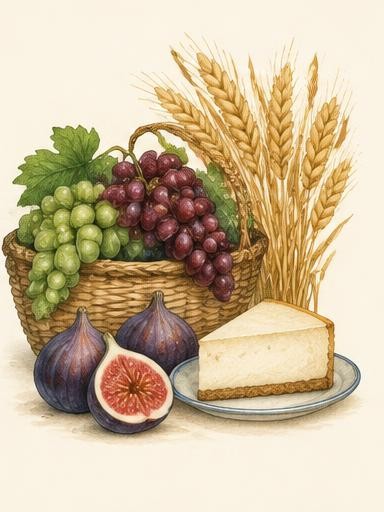
Symbols and what they mean
- Ten Commandments
- The revelation at Sinai.
- First fruits
- Gratitude for the harvest.
- Dairy foods
- Customary food of the festival.
Important prayers and readings
- Reading of the
- Book of Ruth
Foods
- Cheesecake and blintzes
Words to know
The Hebrew vocabulary for this topic.
Vocabulary
- Omer
- The counted period between Pesach and Shavuot.
- Lag B'Omer
- The 33rd day of the count.
- Sivan
- The Hebrew month of Shavuot.
- Tikkun Leil Shavuot
- All-night study on Shavuot.
- Tanakh
- The Hebrew Bible: Torah, Prophets, Writings.
Beth Din prep
Answer these out loud before you sit down with the rabbis.
What I should be able to explain to the Beth Din
1Both meanings of Shavuot: Torah and .
Answer:Historical: the giving of the Torah at Mount Sinai. Agricultural: the wheat harvest and bringing (bikkurim) to the Temple.2What counting the connects.
Answer:We count 49 days from Pesach to Shavuot, linking physical freedom (the Exodus) to its purpose — receiving the Torah.3Why the Book of Ruth is read.
Answer:Ruth is the model convert who chose to join the Jewish people ("your people shall be my people"), it takes place at harvest time, and she is the ancestor of King David.
Key points to be ready to explain
The core ideas of this topic in brief — the things to be able to say in your own words.
- When
- Late spring (May or June), seven weeks after Passover. 6 , at the end of the Counting of the ; one day in Israel, two days in traditional observance · Length: 1 day in Israel; 2 days in the traditional diaspora
- Why
The giving of the Torah at Sinai.
— the early summer harvest offering.
Shavuot celebrates the gift of the Torah.
- How
- Counting of the from Pesach to Shavuot, with Lag B'Omer along the way.
- — study through the night.
- Reading the and the Book of Ruth.
- Eating .
Key symbols: Ten Commandments · First fruits · Dairy foods
- Shavuot falls seven weeks after Passover, in May or June. It celebrates the gift of the Torah at Mount Sinai.
- The Book of Ruth is read on Shavuot. Ruth is the first person in the Bible recorded as a convert; she chose the Torah freely, just as the people did at Sinai.
- Ruth's words: "Your people shall be my people, and your God my God." Knowing the quote is worth even more than remembering the name.
- Two holidays have women as heroes: Ruth on Shavuot and Esther on Purim.